
2026 Jeep Cherokee Overland: A Hybrid SUV Review
 Dan Neil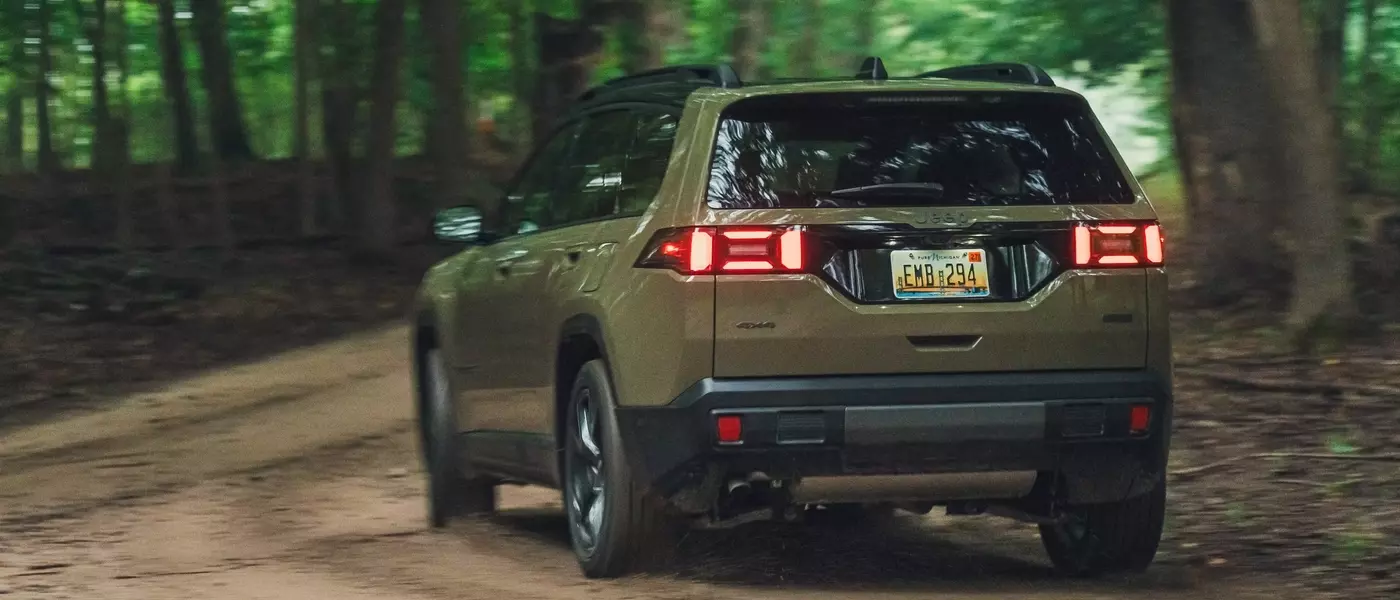
The 2026 Jeep Cherokee Overland marks a new chapter for the venerable nameplate, venturing into the hybrid compact SUV segment with a redesigned exterior and a focus on fuel economy. This iteration distinguishes itself with a more angular, substantial aesthetic, departing from the smoother lines of its predecessor. Inside, the vehicle offers ample space, particularly for rear passengers and cargo, making it a practical choice for various needs. However, the initial foray into a hybrid powertrain by Stellantis, while commendably fuel-efficient, reveals some areas for refinement, notably in overall performance and driving dynamics, as well as certain interior design choices that impact user experience.
The updated Jeep Cherokee features a distinctive, squared-off design that imparts a robust and serious presence on the road. This design philosophy not only enhances its visual appeal but also contributes to practical aspects such as interior packaging. Occupants benefit from generous cabin space, and accessing the rear seats is straightforward. The cargo area behind the second row provides 34 cubic feet of storage, a notable improvement over some competitors, although slightly less than others in its class. Folding down the rear seats expands this capacity to a significant 68 cubic feet, offering versatile hauling capabilities.
Despite the exterior's refreshed appeal, the interior materials in the upscale Overland and Limited trims were found to be somewhat uninspiring, a common observation across many compact SUVs, with a few exceptions like the Mazda CX-50 and high-end Volkswagen Tiguan. While most controls are intuitive, the newly designed octagonal steering wheel poses a significant ergonomic issue. Its unusual shape and excessive thickness make it awkward to hold and, more critically, obstruct the driver's view of essential infotainment screen elements, including the volume control and seat/steering wheel heating functions.
Under the hood, the 2026 Cherokee Overland features its pioneering hybrid system: a turbocharged 1.6-liter four-cylinder engine paired with two electric motors. This combination delivers a total of 210 horsepower and 230 pound-feet of torque, distributed to all four wheels via an electronically controlled continuously variable transmission. While specific off-road enhancements like a two-speed transfer case and electronic locking rear differential are reserved for the upcoming Trailhawk model, the current setup is adequate for typical on-road driving conditions. This powertrain represents Stellantis's initial hybrid offering in the U.S. market, aiming for a balance between power and efficiency.
The vehicle's fuel economy is a standout feature, with EPA estimates of 39 mpg in the city and 35 mpg on the highway. These figures are competitive with the Honda CR-V Hybrid but trail the Toyota RAV4 Hybrid's impressive 46 mpg city and 39 mpg highway. Nevertheless, this makes the 2026 Cherokee the most fuel-efficient Jeep to date. However, the hybrid powertrain isn't without its quirks. The transition between gasoline and electric power is smooth, but the 1.6-liter engine tends to be noisy under acceleration. Furthermore, in stop-and-go traffic, a subtle shudder during throttle engagement and disengagement can become bothersome, hinting at the system's inaugural-generation nature.
Performance-wise, the hybrid powertrain feels less potent in higher-speed driving scenarios. Merging onto highways or overtaking other vehicles requires patience, as evidenced by its 0-60 mph acceleration time of 8.5 seconds and a 5-60 mph rolling start time of 9.3 seconds. These numbers place it at the slower end of the compact SUV segment, comparable to the Subaru Forester Hybrid and notably behind competitors like the Honda CR-V Hybrid (7.1 seconds from 0-60 mph) and the Toyota RAV4 Hybrid (7.1 seconds from 0-60 mph). A significant factor contributing to this performance deficit is the Cherokee's curb weight, which at 4403 pounds, is substantially heavier than its rivals, impacting its overall agility and acceleration capabilities.
Initial impressions of the Cherokee's ride comfort were favorable during testing on smoother California roads. However, when navigating the more challenging and uneven urban landscapes of the New York metropolitan area and Michigan, the chassis tuning revealed some limitations. The vehicle exhibited considerable body motion over bumpy surfaces, feeling both softly sprung and inadequately damped. This characteristic leads to a less composed ride, and despite the soft suspension, the cabin does not effectively isolate occupants from road imperfections, compromising overall comfort in less-than-ideal driving conditions.
The 2026 Jeep Cherokee establishes a presence in the crucial compact SUV market, offering appealing fuel economy for brand enthusiasts. However, its current iteration, while boasting a bold new design and spacious interior, faces challenges in powertrain refinement, acceleration, and ride quality compared to segment leaders. The pioneering hybrid system, while efficient, still requires further development to match the seamless performance of more established rivals. Overall, the latest Cherokee is a commendable effort for Jeep, but it has not yet surpassed the legendary status of the beloved XJ generation in the Cherokee lineage.