
BMW X3 M50 vs. Mercedes-AMG GLC53: A Compact Luxury SUV Showdown
 Akira Maruta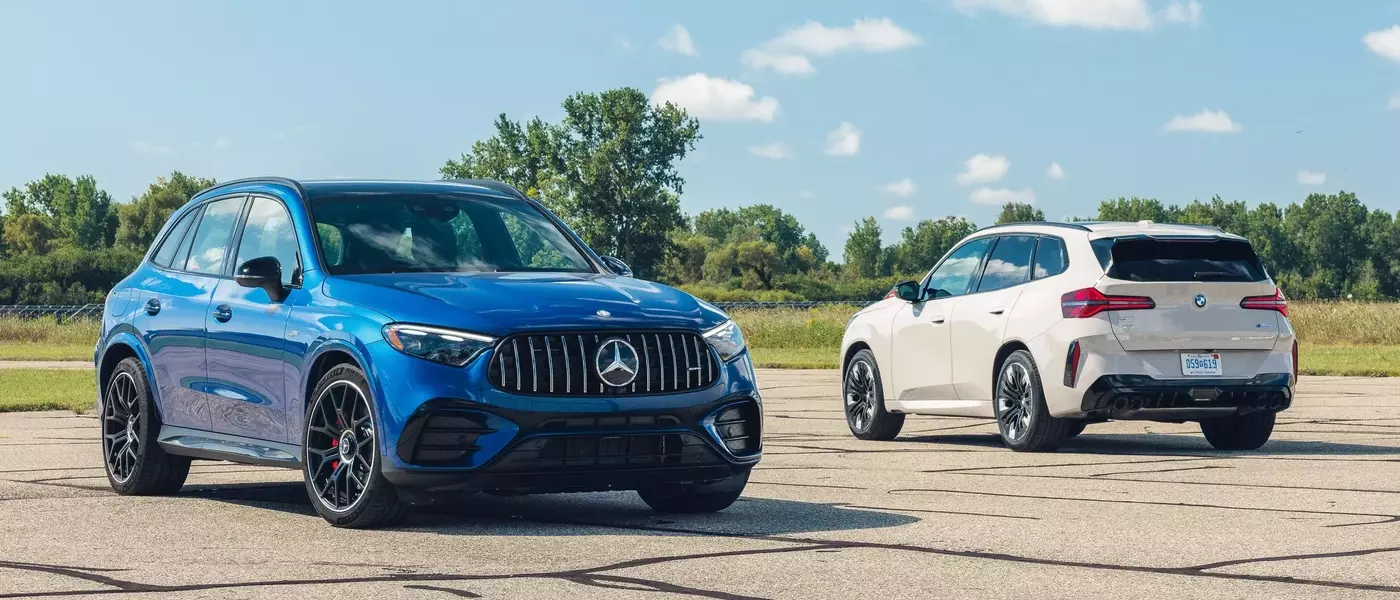
For generations, BMW and Mercedes-Benz have engaged in an intense automotive rivalry, with their latest skirmish pitting two compact luxury SUVs against each other. This detailed comparison features the 2026 BMW X3 M50 xDrive and the 2027 Mercedes-AMG GLC53, both designed to offer heightened performance without compromising luxury or practicality. While the BMW X3 M50 showcases a comprehensive redesign for 2025 with fresh aesthetics and updated technology, the Mercedes-AMG GLC53, though slightly pricier with more indulgent options, emphasizes a more dynamic driving experience. The test evaluates everything from exterior and interior design choices to powertrain capabilities, acceleration figures, braking distances, and overall roadholding, providing a thorough assessment of each vehicle's strengths and weaknesses. This perennial battle between the German automotive giants continues to deliver compelling choices for discerning drivers, each brand striving to outdo the other in innovation and driver satisfaction.
The X3 M50, starting at $67,850, includes adaptive suspension, M Sport brakes, a panoramic sunroof, and heated front seats. Optional enhancements such as the Premium package ($2750), M Sport Professional package ($600), rear climate controls ($200), and Dune Grey Metallic paint ($650) brought its total to $72,050. In contrast, the GLC53, with a base price of $71,350, comes with standard features like a panoramic sunroof and heated front seats. However, its optional extras, including 21-inch AMG wheels ($2850), the AMG Dynamic Plus package ($2000), Driver Assist package ($1950), black leather upholstery ($1620), Starling Blue Metallic paint ($750), AMG Night package ($750), ventilated front seats ($450), Advanced USB package ($300), and the extensive Pinnacle Trim ($3900), pushed its as-tested price to $85,920. The pricing disparity and option philosophies reflect each brand's approach to luxury and customization.
Design and Interior Appointments
The 2026 BMW X3 M50 introduces a controversial twin-kidney grille design that, while distinctive, has divided opinion among enthusiasts. Beyond this prominent front fascia, the X3's exterior adheres to a standard compact SUV silhouette, characterized by an upright rear hatch and ample body contours for visual interest. Its interior, despite attempts at reinvention with angular door controls and haptic feedback panels, is criticized for design choices that prioritize novelty over user-friendliness. However, the cabin excels in spaciousness, particularly in the rear, offering superior legroom and foot space compared to its rival. The front seats masterfully combine comfort with support, ensuring a pleasant experience even during spirited driving. With 32 cubic feet of cargo space behind the second row, it boasts a significant advantage over the GLC53, comfortably accommodating eight carry-on bags.
Conversely, the 2027 Mercedes-AMG GLC53 presents a more contemporary grille featuring a prominent central star. Its profile is distinctly more rounded, with a pronounced hatchback rake and fewer sharp lines, giving it a beefier and more substantial appearance than the X3. Inside, the GLC53 offers materials that feel a step above in quality, and its overall design avoids unnecessary complexity, providing a familiar and user-friendly infotainment system. Although its haptic steering wheel controls can be somewhat cumbersome, the infotainment screen is intuitive, requiring minimal taps to access functions. While slightly less spacious, particularly in the console area which can impinge on legroom for some drivers, its interior design is perceived as more refined and cohesive. The GLC53 offers 22 cubic feet of cargo space, enough for eight carry-on bags, matching the X3 in this practical measure despite its smaller overall volume.
Performance and Driving Dynamics
Both the BMW X3 M50 and Mercedes-AMG GLC53 are powered by a 3.0-liter inline-six engine with 48-volt hybrid assist. The X3 M50’s turbocharged engine produces 393 horsepower and 428 pound-feet of torque, paired with an eight-speed automatic transmission. In contrast, the GLC53’s engine, featuring both turbocharging and an electric supercharger, delivers a more robust 443 horsepower and 443 pound-feet of torque, with a brief overboost to 472 pound-feet, and is mated to a nine-speed automatic transmission. This power advantage translated into superior acceleration for the GLC53, which reached 60 mph in 3.7 seconds and completed the quarter-mile in 12.2 seconds at 113 mph. The X3 M50, though still quick, managed 0-60 mph in 4.0 seconds and the quarter-mile in 12.6 seconds at 110 mph. The GLC53 also demonstrated superior braking, stopping from 70 mph in 147 feet compared to the X3 M50's 166 feet, and exhibited better grip with 0.94 g on the skidpad versus the X3 M50's 0.85 g. However, the X3 M50 achieved better fuel economy, averaging 28 mpg against the GLC53's 23 mpg.
The driving experience in the X3 M50 is characterized by a potent and acoustically pleasing powertrain, complemented by a competent handling loop performance thanks to its front strut and rear multilink suspension and Pirelli P Zero all-season tires. While it handles mid-corner corrections gracefully, it offers limited driver feedback, requiring a degree of trust in the vehicle’s capabilities during demanding maneuvers. The engine's substantial torque available from low RPMs ensures immediate thrust. The GLC53, on the other hand, offers a more engaging and extroverted driving character. Its massive Michelin Pilot Sport 4 SUV tires provide exceptional grip and resistance to tramlining, while its sophisticated four-link front suspension and rear-wheel steering enhance agility and make it feel remarkably nimble for its size. Despite being 195 pounds heavier than the X3, the GLC53’s additional power effectively compensates for the weight difference. Both SUVs deliver smooth and quiet highway rides, performing admirably in daily commuting scenarios. However, both transmit significant impact and noise into the cabin when encountering rough road surfaces or expansion joints, indicating a shared characteristic in their ride quality over challenging terrain. Ultimately, the GLC53's dynamic superiority and communicative chassis make it the more compelling choice for drivers seeking an exhilarating experience.