
Home Depot Navigates Leadership Transition Amidst Earnings Release
 Chika Uwazie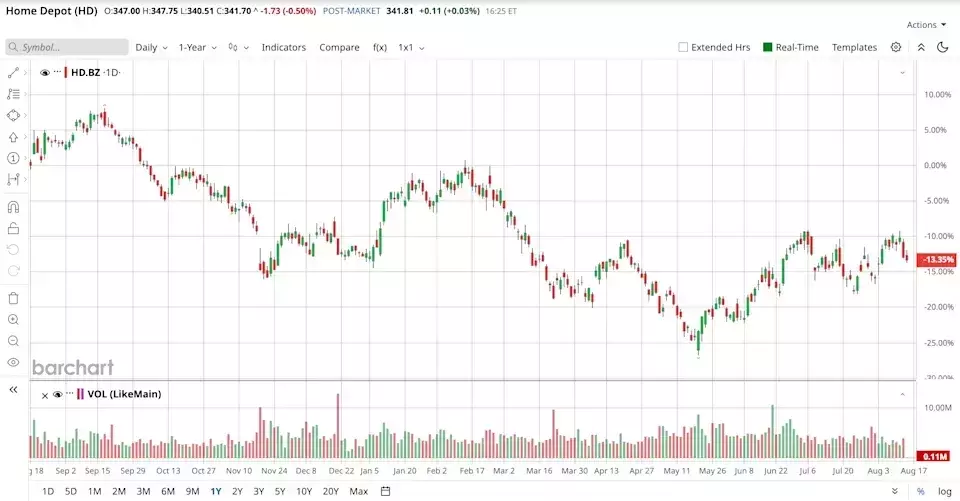
Home Depot faces a temporary leadership change as CEO Ted Decker takes a medical leave for several months, coinciding with the upcoming fiscal second-quarter earnings announcement. Investors are closely watching this development, particularly as the company prepares to release its financial results on August 18th, which will offer insights into housing market conditions and consumer spending habits.
Despite the unexpected timing, the company has taken proactive steps to ensure continuity. Home Depot has not appointed an interim CEO; instead, it has strategically divided Decker's responsibilities between two seasoned executives. Ann-Marie Campbell, the senior executive vice president of U.S. stores and operations, will oversee operational aspects, while CFO Richard McPhail will manage financial matters and the company's Pro divisions. This measured approach suggests that the company views this as a temporary governance matter rather than a fundamental shift in its investment outlook. The upcoming earnings report will be crucial in assessing Home Depot's resilience in the current economic climate, particularly its performance in comparable sales, significant transactions, and demand within its professional contractor segment.
The company's performance in the fiscal first quarter demonstrated its ability to achieve moderate growth despite a challenging housing market, with revenue increasing by 4.8% year-over-year to $41.8 billion. Comparable sales saw a modest rise of 0.6% globally and 0.4% in the U.S., while adjusted earnings per share reached $3.43, exceeding analyst expectations. Home Depot has reaffirmed its fiscal 2026 guidance, projecting total sales growth of approximately 2.5% to 4.5% and adjusted earnings per share growth of up to 4%. The Wall Street community maintains a "Moderate Buy" rating for Home Depot, indicating a cautious yet optimistic view. The stock's valuation, trading at about 23.62 times forward price-to-earnings, reflects its scale, profitability, and potential for future recovery in the housing sector, emphasizing the importance of strong earnings growth for sustained valuation improvement. Therefore, the company's future stock performance is more likely to be influenced by the recovery of housing turnover, remodeling activities, and major projects, rather than the temporary leadership adjustment.