
US Consumer Sentiment Drops Amidst Economic Concerns
 Chika Uwazie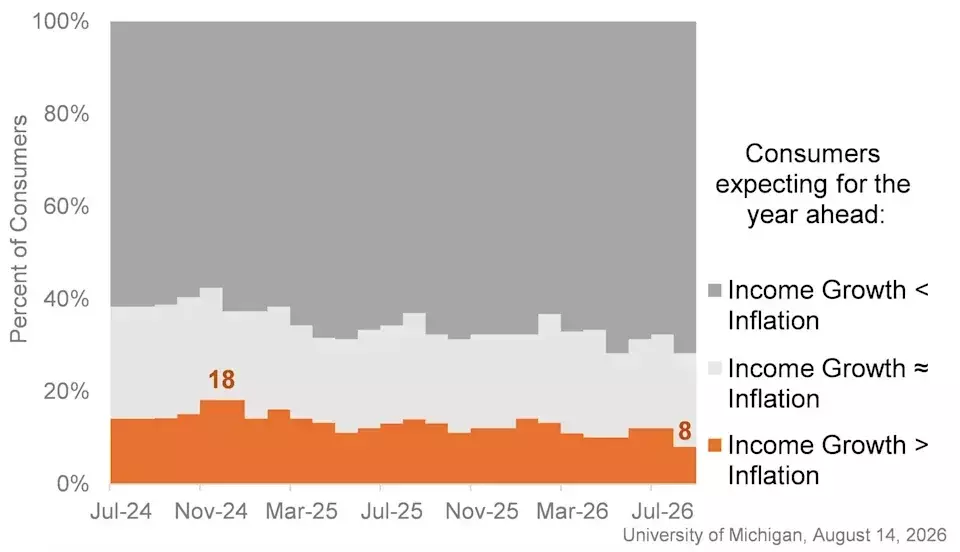
In August, American consumers experienced a notable decline in confidence regarding the economic landscape. This shift was largely driven by ongoing inflation worries, escalating geopolitical uncertainties, and an increase in bond yields. The University of Michigan's survey revealed a substantial dip in sentiment, prompting concerns about the trajectory of consumer spending and overall economic stability.
US Consumer Confidence Plummets in August Amidst Economic Headwinds
On a somber Friday, August 14, 2026, the University of Michigan released its preliminary consumer sentiment report, painting a grim picture of American economic outlook. The Index of Consumer Sentiment plummeted to 51, a significant drop from July's 55.2 and well below economists' forecasts of 55. This marked the end of two consecutive months of cautious optimism, indicating a broad-based unease among the populace.
The downturn in sentiment was not isolated, as both the current economic conditions index and consumer expectations index also registered disappointing figures. The current conditions index settled at 51.8, falling short of the estimated 54.8, while the expectations index reached 50.6, missing the projected 55.2. Joanne Hsu, the survey director, highlighted that this weakening sentiment was pervasive across various demographic groups, with particularly pronounced reductions observed among older consumers, lower-income households, and individuals without a college degree. These groups, she noted, are inherently more susceptible to the erosive effects of inflation on their purchasing power.
Adding to the bearish sentiment, consumers' predictions for year-ahead inflation edged up to 4.3% from 4.2% in July, a concerning signal for markets grappling with persistent above-target inflation. While longer-term inflation expectations (5 to 10 years) remained stable at 3.3%, a mere 8% of consumers anticipate their income growth will outpace inflation in the coming year. These figures stand in stark contrast to recent data from the Bureau of Labor Statistics, which showed a slight easing in both consumer (CPI) and wholesale (PPI) inflation in July.
Specifically, the Consumer Price Index saw a 3.4% year-over-year increase in July, a modest decrease from June's 3.5%, despite a monthly rise of 0.1%. On the wholesale side, the Producer Price Index, excluding food, energy, and trade services, advanced by 4.7% in July, exceeding expectations of 4.6%, though it was down from June's 5.1%. Paradoxically, this mixed inflation data was sufficient to prompt traders to scale back their bets on a Federal Reserve rate hike in September. Following a weaker-than-expected July jobs report, market odds for a September hike had been evenly split. Now, approximately 70% of the market anticipates the Fed will maintain current rates, though at least one rate increase is still factored in by December.
Further compounding the economic uncertainty, retail sales data released by the Department of Commerce concurrently revealed a 0.6% monthly decline in sales, a significant disappointment against expectations of a 0.1% increase. This downturn in retail activity underscores lingering concerns about the true resilience of American consumers in the face of ongoing economic challenges.
The latest consumer sentiment data serves as a crucial reminder of the delicate balance within the economy. Despite some indicators showing a deceleration in inflation, the public's perception, heavily influenced by their everyday experiences with rising costs, dictates spending behavior and, ultimately, economic growth. This report urges policymakers and businesses to consider not just statistical data, but also the psychological impact of economic conditions on the average American. Addressing core concerns like purchasing power erosion and providing clear, reassuring economic guidance will be vital in rebuilding consumer confidence and fostering a more stable financial environment. The continuous monitoring of these sentiment shifts is imperative for navigating the evolving economic landscape effectively.